Virtual Production Without Limits: How Gorodenkoff Productions Is Redefining Commercial Filmmaking
The System-Driven Studio: Many people view virtual production as just a high-tech backdrop, but your studio emphasizes treating virtual production like a "high performance system" with clear logic and absolute predictability. For global Executive Producers and brands meeting you for the first time via GPN, how would you briefly describe the Gorodenkoff philosophy of blending physical filmmaking with digital environments?
For us, the technology itself is not the point. An LED wall is now widely available, and the wall is not what determines the quality of the work. What sets us apart is the structure and the approach behind it. We operate as a single vertically integrated company, so that production, production service and the virtual production studio function as one system rather than as a chain of separate vendors. This is what allows us to treat virtual production as a high-performance system - one that is predictable, measurable and scalable. The greatest value in virtual production comes at volume, and that is where having the right people in-house makes the difference. Our Unreal Engine artists work within our own VAD, so the digital environments are built alongside everything else. The art department has been with the studio for years and knows the workflow, so when a question comes up on a build they can make the right call straight away, or guide the other parties involved. Our producers have real technical and structural experience in virtual production, so they understand how it behaves and plan around it. We are also able to hold on to client's assets: physical ones for twelve to twenty-four months and virtual ones indefinitely, or for as long as the law requires. We are able to offer this because the teams that built them are in-house and familiar with them. It is not an obligation, but it means they are there if a client wants to use them again. And the client does not have to work out how to reuse them, we handle that, and we can quantify the cost efficiency and the environmental impact in each case. What we ultimately offer, therefore, is not a backdrop, nor simply a studio, but a structure - the predictability, transparency and economics of a fully integrated production pipeline.
The Stock Media DNA: Gorodenkoff originally built its foundational legacy as a global leader in high-end, premium stock footage before expanding into full-service commercial production. How did the intense creative discipline, volume, and hyper-efficiency required to succeed in premium stock media shape the way you design your workflows for massive international brand campaigns today?
We built our first studio during the COVID period. This was not long after The Mandalorian had pioneered the technology in its current form. At that time, the restrictions on accessing locations gave us a reason to explore virtual production seriously. We then spent years applying it to stock production, which is a business that depends on volume without any compromise on quality. That experience is what led us to the vertically integrated structure we use today.The same discipline shaped how we built the company. We grew the team and invested in equipment against strictly defined business objectives: to increase volume and reduce cost.
Today around twenty people work in-house, including producers, Unreal Engine artists and a dedicated art department. Each role is clearly defined to complement the others and serve those same objectives. Nothing in the structure is incidental. It was assembled to perform.What we are doing now is bringing that to commercial clients. The structure that has worked for us in stock production for many years is the same one we offer to international brand campaigns. This gives clients the opportunity to capitalise on a system that is already proven, rather than one being built for the first time on their project.
Physical Roots, Digital Future: Unlike many virtual studios that started purely as tech or VFX houses, you have deep roots in traditional service production (handling everything from casting to physical construction). Why is a deep understanding of traditional, on-the-ground physical production service crucial to executing flawless virtual production on an LED stage?
Virtual production does not divorce the physical from the digital. The two work together throughout the process. On a typical set, only around sixty percent is digital. The rest is built and lit in the room, in front of the camera. This is exactly where virtual production outperforms both traditional and full CG approaches. It combines the best of both. You have the freedom to place a scene in any location, while preserving authenticity through real, physical set builds. Actors can interact with something tangible rather than imagining it. Reflections from the LED volume fall naturally onto the physical set elements, the way they would on a real location. And the conditions you could never control outside become controllable. A golden hour that lasts minutes on location can last the entire shoot day in the studio.This is why on-the-ground production experience matters. A studio that began purely in technology or VFX tends to treat the physical side as secondary. We do not. Casting, art direction and physical construction are disciplines we have practised for years, and they are what make the digital side convincing. Flawless execution on an LED stage depends on getting the physical work right first.
Dismantling the Tech Barrier: Directors and DP’s sometimes worry that virtual production environments restrict their creative spontaneity. Your studio has combined advanced systems like the 70m² LED Volume, Zeiss Cincraft camera tracking, and the MRMC Bolt motion control robot. How do you pitch this tech setup to creatives to prove it actually unlocks more artistic freedom rather than limiting it?
This concern usually comes from past experience with virtual production rather than from the technology as it stands today. It is a young field, only about seven years old. An unsatisfactory project from even three or four years ago can leave a lasting impression, and many creatives are still working from that memory. The reality is that most current setups perform orders of magnitude better than what was available then. Ours in particular has been improved steadily over the years, through our own investment, to the point where we are genuinely comfortable working with it. We have been shooting with it twice a week for stock production for years, so it is not an experimental rig we are learning on the client's time. We have had directors and DPs arrive expecting the same issues they remember from a few years ago, and leave pleasantly surprised. And we are taking this further with the new studio we are building, which will carry 252m² of LEDpanels: 180m² on the main wall, 60m² overhead, and a movable 12m² section. It is designed around the latest available technology, with no compromises on quality. On the question of creativity, virtual production does far more than recreate real locations under controllable conditions. It also lets you push the boundaries of what can be shot inside a studio almost without limit. Any set that is surreal, historical, or conceptually impossible because the location is inaccessible can be built and shot in the studio. And it can be done with extreme precision, with no trade-offs against the creative vision of the director, DP or creative director. There are really only two minor limitations when writing for virtual production: extreme slow motion, and keeping the LED wall itself out of focus. Beyond that, when you combine material written with virtual production in mind and an experienced partner who can guide you through the whole process, what you put on the table for the client is effectively limitless.
The 15-Minute Turnaround: In your recent case study for Sagrotan, your in-house construction crew completely dismantled a physical bathroom set—including walls, tiles, and flooring—during a 15-minute lunch break to shift seamlessly to a virtual kitchen set. Can you talk about why agile physical art direction and custom modular staging are just as important to your studio's ecosystem as Unreal Engine pixels?
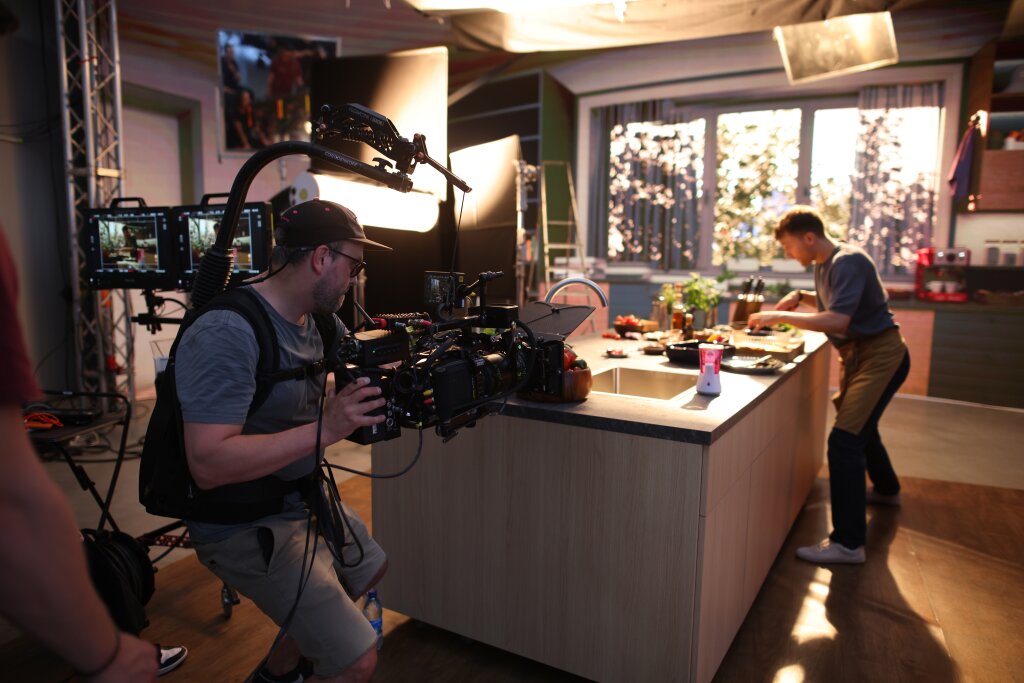
The bathroom was built largely as a traditional set, with the LED wall used to display the view through the window. The kitchen, by contrast, was a classic VP set. The beauty of such set is that all we had to do was dismantle the old build and move the physical kitchen island into a frame we had prepared earlier, while the rest of the kitchen, built in Unreal Engine, blended in perfectly on the LED wall. That is what made the fifteen-minute turnaround possible. This speaks directly to our earlier point. In virtual production, the physical and the digital are not separate. They complement each other in the most elegant and efficient way possible, and the result on screen depends on both being done well. The value of that combination becomes clear when you consider the pace it allows. Imagine moving through four, five or six locations like that in a single day. Now imagine having an influencer or a celebrity present in every one of them, without a single flight or location move. A great deal of value emerges from the technology itself. Our approach to that technology is what extracts the last part of it.
The Baltic Edge: Operating out of Tallinn, Estonia, you are rapidly expanding with a massive new 1,350 m² studio hub. What makes Estonia and the wider Baltic region an incredibly competitive, logistically seamless hotspot for international agencies looking to execute complex multi-market audiovisual campaigns?
It is worth clarifying what the hub actually is. We already operate a 550 m² studio with a 70 m² LED screen, and we are now building a new 1,350 m² studio alongside it, including an 800 m² stage. The new studio will carry 252 m² of LED panels: 180 m² on the main wall, 60m² overhead, and a movable 12 m² section. With the two sitting directly next to each other, you can run several projects simultaneously or use both for a single multi-stage production. Estonia is a strong base for this kind of work for several reasons. It is a clean, compact and safe country to operate from. Our studios in Tallinn are only fifteen minutes from the airport and fifteen minutes from the city centre, where the best hotels and the infrastructure a production needs are all located. The country is also already on the map for commercial production, with international clients consistently satisfied with the professionalism of the local crews. What makes it genuinely seamless, however, is the near-absence of bureaucracy. Most public services here are online, so location permits are quick and easy to obtain, paying people is straightforward and transparent, and the tax system is both friendly and convenient to work with. And there is no language barrier. English is spoken fluently right across the population here, so communication on set and in planning is never an obstacle. For an international agency running a complex, multi-market campaign, that combination removes a great deal of the friction that usually slows production down.
The Case for Greener Filmmaking: Virtual Production is often praised for cost- efficiency, but you also explicitly highlight it as a smarter path for green, sustainable filmmaking. How are global brands responding to the idea of replacing cross-border flights, carbon-heavy transport, and physical material waste with real-time digital environments?
Virtual production is greener first and foremost because it significantly reduces travel, which cuts both carbon footprint and physical waste. There are also several less obvious reasons. Our studio buys its electricity from a average greener than that of most other regions. There is also no reliance on fossil-fuel energy sources such as the generators that location shoots typically require. And physical waste is lower again because the crews needed to manage a virtual production shoot tend to be considerably smaller. We are taking this further still. We offer clients the opportunity to store and reuse physical assets over an extended period, rather than discarding and rebuilding them. We are also keen to measure environmental impact against each client's ESG reporting or internal criteria, whether their projects run back to back or unfold over several years.
The Partnership: As a cutting-edge virtual production studio and full-service hub, what made you choose to align your company with the GPN network, and how do you see this partnership changing the game for global clients who need predictable, high-quality execution without geographic limitations?
For us, GPN began as a pleasant connection. Our producers met the network when they attended Ciclope Berlin, and we quickly understood that we align on all the key goals when it comes to commercial production. Several of the qualities GPN holds as its values matter a great deal to us: reliability, transparency, and, most importantly, a genuine desire to explore and to educate both clients and vendors on new and innovative approaches to audiovisual production. Despite having been in the field for years, GPN is clearly not afraid to push progress forward. That is exactly what our own ambition is built around. We are not trying to replace traditional production. We are working to move the needle on virtual production, from something seen as a high-tech backdrop to a scalable strategy that many industries can capitalize on. Aligning with a network that shares that outlook, and that connects us with clients who need predictable, high-quality execution without geographic limitations, is what makes this partnership valuable for everyone involved.